



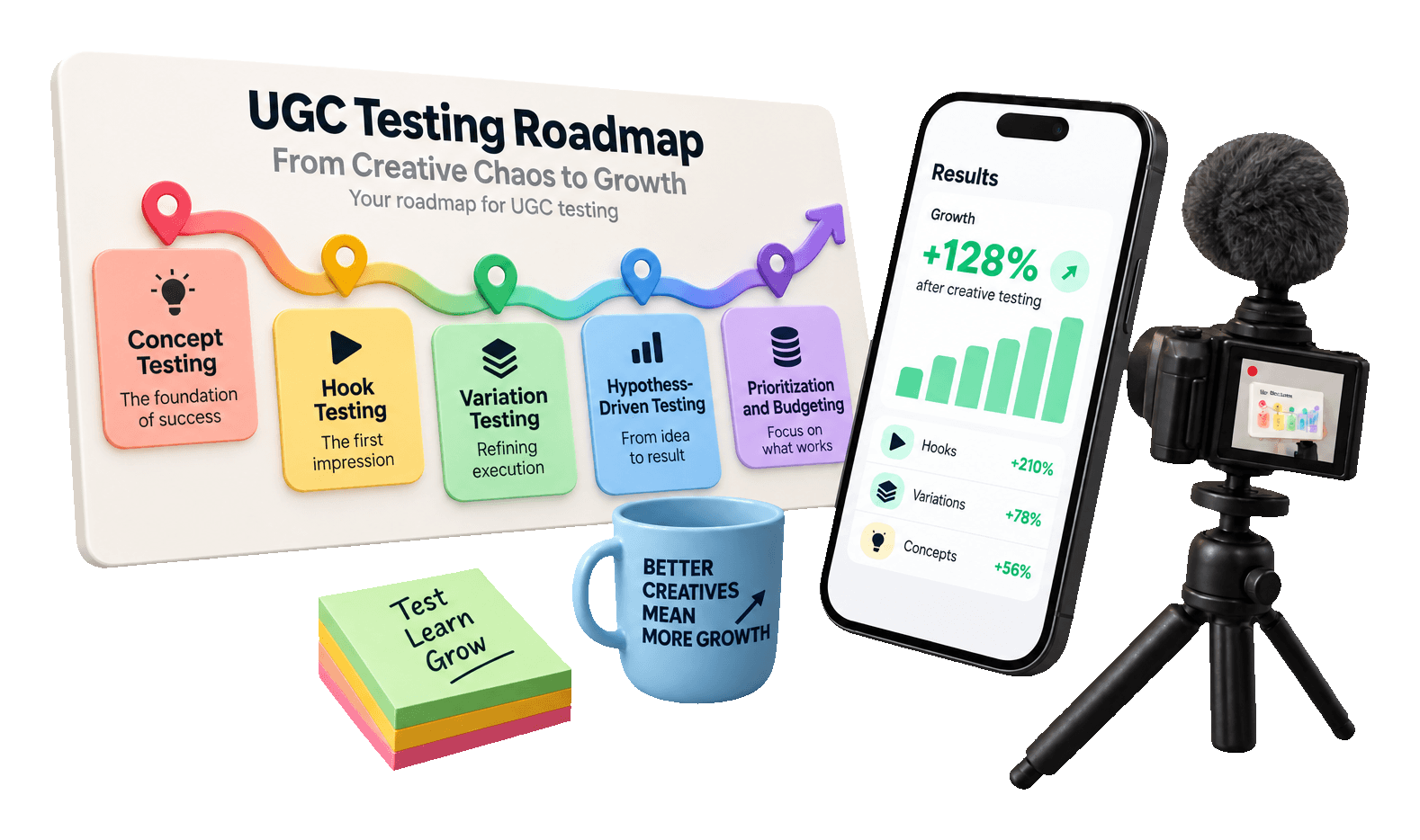
In the world of user-generated content (UGC), it's crucial to understand what works and why. However, creative tests can often lead to confusion by changing too many variables at once. This results in noise and unclear outcomes.
A creative testing roadmap provides structure and clarity. By defining what you test, when, and with which success criteria, you can learn more efficiently and make better use of your budgets. This approach ensures a faster learning curve and better decisions.
TL;DR
- A creative testing roadmap helps you test in a structured way and scale results.
- By sequencing tests on concept, hook, and variation, you increase learning speed.
- Protect your test budget to gain reliable insights and avoid ad-hoc decisions.
In this article, you'll discover how to set up a creative testing roadmap, which elements are essential, and how to apply it to UGC.NL to optimize and scale your campaigns.
What is a Creative Testing Roadmap?
A creative testing roadmap is a forward-looking plan that defines which creative experiments will be conducted, when they start, how much budget they receive, and how success is measured. Instead of reacting to performance changes, teams use a roadmap to plan tests deliberately, so each experiment answers a clear question about audience motivation or messaging.
It's not about more tests, but about better tests. By adopting a structured approach, you prevent multiple variables from changing simultaneously, making it easier to understand why performance changes and which insights are worth scaling.
Essential elements
A strong creative testing roadmap breaks tests into clear layers, allowing teams to learn what drives performance before moving on to execution details. By isolating each layer, marketers can identify which ideas deserve more investment and which should be scrapped early.
Avoiding pitfalls: When creating a creative testing roadmap, it's important not to plan too many tests at once. This can lead to confusion and unclear results. It's more effective to stay focused and test one variable at a time. This way, you gain clear insights into what works and what doesn't, and you can allocate your budget more effectively.
Concept Testing: The Foundation of Success
Concept testing focuses on the core promise of an ad, such as a pain point, desired outcome, or belief the audience already holds. This is where teams validate what truly motivates action before investing in execution. Since the concept forms the entire message, it typically has the greatest impact on performance and should be tested before making smaller creative adjustments.
Strong concept tests answer questions like which problem resonates most or which outcome feels most compelling. This gives teams a clear direction for future iterations.
Practical application
On UGC.NL, you can test concepts by using our creator marketplace. Choose a creator that matches your target audience and let them try out different concepts. This provides insight into what works before moving on to the next test layers.
A common mistake in concept testing is not segmenting your audience sufficiently. It can be tempting to appeal to a broad audience, but it's often more effective to focus on specific segments. On UGC.NL, you can use the AI Search feature to find creators that perfectly match your target audience, helping you conduct targeted concept tests.
Hook Testing: The First Impression
Hook testing isolates the opening seconds or headline to understand what grabs attention. By keeping the underlying concept constant and only changing the hook, teams can determine which angles capture early attention.
This helps separate attention issues from messaging issues, preventing premature changes to ideas that may still have demand. Effective hook testing improves learning speed and ensures strong concepts aren't killed by weak opening lines.
How to do this
Use the direct chat on UGC.NL to collaborate with your chosen creator to test different hooks. By providing quick feedback and making adjustments, you can determine which hooks have the most impact.
Impact of hooks: The first seconds of a video are crucial. A strong hook can make the difference between a viewer staying engaged or scrolling past. At UGC.NL, you can quickly collaborate with creators via direct chat to optimize hooks. By working with creators who understand your target audience well, you increase the chance of making a successful first impression.
Variation Testing: Refining Execution
Variation testing explores execution details once a concept has shown demand. This includes changes in visuals, CTAs, captions, creators, or formats while keeping the core message intact.
The goal is to extend the lifespan of winning ideas without introducing new strategic variables that complicate analysis. Variation testing helps teams scale what works by adapting execution to different audiences, placements, or fatigue signals, rather than starting over.
UGC.NL approach
With the revisions included with every order on UGC.NL, you can easily test and adjust different variations until you find the right combination that resonates with your audience.
In variation testing, it's essential to find the right balance between consistency and creativity. Too many variations can lead to confusion, while too few can limit effectiveness. With the revisions on UGC.NL, you can easily test and adjust different executions, ultimately finding the most effective content.
Hypothesis-Driven Testing: From Idea to Result
Hypothesis-driven testing turns creative ideas into testable statements instead of gut-feeling guesses. Each experiment is framed as a simple cause-and-effect hypothesis that links a specific message to a specific outcome.
This forces teams to be explicit about why they believe a creative will work before it's ever launched. Even a losing test provides a clear conclusion about what didn't resonate, informing the next roadmap decision.
Example
Suppose your hypothesis is: "If we emphasize the time-saving benefit in the first three seconds of the ad, then CTR will increase for cold audiences." Test this by keeping the concept and visuals the same but producing two versions that only differ in the opening hook.
A good hypothesis is specific and measurable. It's important to clearly define what you want to learn from a test in advance. This not only helps in interpreting the results but also in making future decisions. At UGC.NL, you can use ad-performance data to refine your hypotheses and support your tests with hard numbers.
Prioritization and Budgeting: Focus on Valuable Experiments
Prioritization frameworks help teams decide what to test first when ideas exceed budget and capacity. Instead of debating opinions, concepts and hooks are scored against a consistent set of criteria.
This ensures that testing resources are spent on ideas likely to yield meaningful learning experiences or performance improvements. By applying prioritization consistently, teams avoid chasing shiny ideas and keep their creative testing roadmap focused on the most valuable experiments.
Budget protection
Protect your test budget by using the packages on UGC.NL. This ensures that each concept receives enough delivery to be fairly evaluated and consistently compared over time.
When prioritizing tests, it's crucial to remain objective. It can be tempting to be guided by personal preferences, but it's more effective to rely on data. By using the packages on UGC.NL, you can efficiently allocate your testing resources and ensure you're investing in the most promising ideas.
Translating Results into Scalable Decisions
Testing is only valuable if results are translated into disciplined, repeatable decisions. Before a creative goes live, teams must align on what success looks like – whether that's CPA, CTR, or early engagement signals.
When a creative meets its goals, the next step isn't to aggressively increase the budget. Instead, top teams first expand horizontally, applying the winning concept to new hooks, creators, formats, or placements to validate that performance remains consistent across variations.
UGC.NL advantage
With the AI Search feature on UGC.NL, you can quickly find new creators that fit your winning concepts, allowing you to effectively scale your campaigns without losing consistency.
A successful test should lead to scalable decisions. This means not only looking at the immediate results but also the potential to replicate these results. With UGC.NL's AI Search feature, you can quickly find new creators that fit your winning concepts, helping you effectively expand your campaigns.
The Role of Creators in the Testing Process
Creators play a crucial role in the creative testing process. Their unique perspectives and creativity can offer new angles you might overlook. At UGC.NL, businesses can communicate directly with creators via the in-platform chat, fostering close collaboration that enhances the quality of tests.
It's important to find a good match between your brand and the creator. UGC.NL facilitates this by offering an extensive creator marketplace where you can select creators based on their niche, language, and other relevant criteria. This increases the chance of a successful collaboration and effective tests.
Additionally, creators can help interpret test results. Their experience and insights can provide valuable feedback that you can use to adjust your strategy. By collaborating with creators who understand your brand and audience, you can elevate your creative tests to a higher level.
Feeding Feedback Back into the Roadmap
A creative testing roadmap should evolve with each test cycle, not remain unchanged. Each round of results should directly influence what is tested next.
Strong performances point the way to new hooks or variations, while underperforming tests clarify which messages, formats, or angles should be avoided. This feedback loop allows teams to build on real signals rather than starting from scratch each week.
Continuous improvement
By continuously integrating feedback into your roadmap using the ad-performance data on UGC.NL, you can maintain momentum, avoid double work, and increase gains over time.
A dynamic roadmap is essential for success. By continuously integrating feedback, you can adjust and improve your strategy. UGC.NL offers comprehensive ad-performance data, allowing you to base your roadmap on real results. This enables you to continually refine and optimize your creative strategy.
Available Now
Start setting up your creative testing roadmap today and discover the power of structured experiments. Discover it yourself
Frequently asked questions
On UGC.NL, you can test concepts by choosing creators that match your target audience. Let them try out different concepts and analyze the results with our ad-performance data.
You pay from €59 per video. This amount includes the cost of testing different hooks and using our direct chat for quick feedback and adjustments.
The delivery time for videos on UGC.NL is 3–5 days. This allows you to quickly test and iterate based on the results, accelerating your learning curve.
Use the packages on UGC.NL to protect your test budget. This ensures that each concept receives enough delivery for fair evaluation and consistency over time.
UGC.NL offers revisions. If your test doesn't deliver the desired result, you can make adjustments and retest at no extra cost, thanks to the included revisions.